
Kiyomizu-dera Temple Panoramic Views: Complete Visitor Guide
Kiyomizu-dera Temple sits on a forested hillside in eastern Kyoto, drawing millions of visitors every year. Its iconic wooden stage delivers some of the most sweeping panoramic views in all of Japan. This Kiyomizu-dera Temple panoramic views visitor guide covers everything you need — timing, access, fees, and how to beat the crowds. Whether you are a first-time traveler or returning to Kyoto, this guide helps you plan a smarter, more rewarding visit.
Kiyomizu-dera is one of Kyoto's most celebrated landmarks, and for good reason. The climb to the main hall rewards visitors with breathtaking city views, centuries of history, and a handful of memorable rituals. Explore the full range of tourist attractions in Kyoto before you finalize your itinerary.
What Is Kiyomizu-dera Temple?
Kiyomizu-dera Temple was founded in 778 CE by the monk Enchin, who discovered a sacred waterfall on the hillside of Higashiyama Ward. According to legend, he built a small hall beside Otowa Waterfall after receiving a divine vision urging him to do so. The temple became one of Kyoto's most important religious sites over the following centuries. In 1994, it was inscribed as part of the UNESCO World Heritage Site known as the Historic Monuments of Ancient Kyoto.
The most famous feature of Kiyomizu-dera is its main hall, which extends over a steep cliff on a massive wooden stage. This construction technique is called kake-zukuri, meaning "hanging construction." The stage is supported by 139 pillars made from Zelkova wood, assembled entirely without nails. The structure has been rebuilt multiple times using the same traditional method, most recently in the 1630s.
For international visitors, Kiyomizu-dera is one of the most unmissable tourist destinations outside Tokyo. The temple complex spans multiple buildings, shrines, and stone paths that wind through a forested hillside. Plan at least 90 minutes to explore the main attractions without feeling rushed. Most visitors find the combination of history, architecture, and views worth every step of the uphill walk.
Why the Panoramic Views Are Worth the Climb
The Kiyomizu Stage sits roughly 13 meters above the hillside forest floor, giving visitors an open, elevated view of Kyoto. On a clear day, the cityscape stretches all the way to the Higashiyama mountains in the distance. The stage faces west, which makes late afternoon light warm and flattering for photos. Morning visits before 8 AM offer softer light and far fewer people in the frame.
The best photo positions on the stage are the far left and far right corners, where you can capture the building itself against the tree canopy. From those corners, the vermilion Three-Story Pagoda appears in the background, adding color and depth to your shot. The center of the stage works well for wide-angle cityscape shots but gets crowded quickly after 9 AM. Arriving at opening time (6:00 AM) gives you the clearest views with almost no competition for space.
Even on overcast days, the stage view holds its own — the mist rolling through the forested hillside has its own dramatic quality. Autumn visits in mid-November frame the stage with vivid red and orange maple leaves below. Spring visits in late March and early April surround the wooden structure with cherry blossom clouds. Both seasons are spectacular, but both also bring the heaviest foot traffic of the year.
Top Things to See at Kiyomizu-dera Temple
The temple complex holds several distinct attractions beyond the famous stage. First-time visitors often focus only on the main hall and miss some of the most rewarding spots. Knowing what to look for before you arrive helps you use your time well. Below are the five highlights worth prioritizing during your visit.
Otowa Waterfall is located directly beneath the main hall and is one of the most visited spots in the complex. Three separate streams fall into a basin below, and each stream is said to grant a different blessing — longevity, love, or academic success. Visitors traditionally drink from only one stream using a long-handled ladle, as drinking from all three is considered greedy. Expect a queue of 5 to 20 minutes at busy midday periods, shorter at opening time.
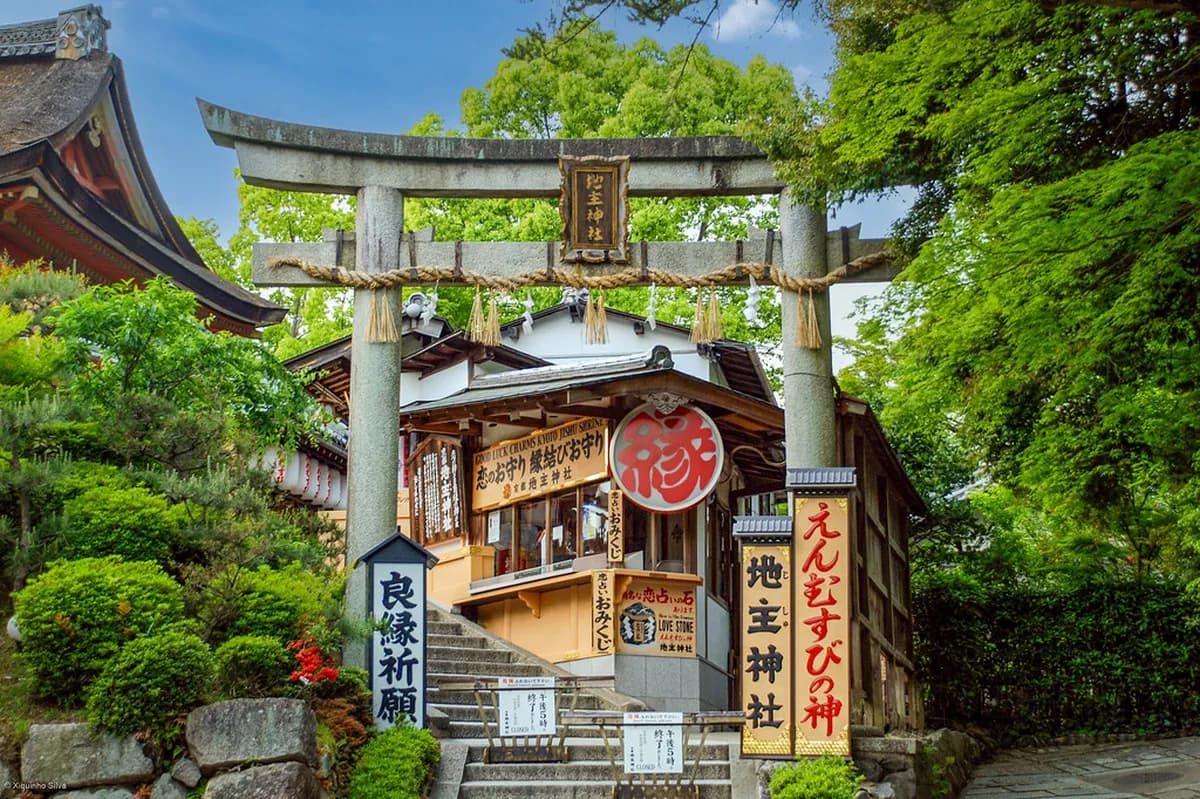
Jishu Shrine, located just above the main hall, is dedicated to the god of love and matchmaking. Two stones sit roughly 18 meters apart in the shrine grounds, and local tradition holds that walking from one to the other with eyes closed means your wish for love will come true. The Niō-mon Gate marks the dramatic entrance to the temple path and is flanked by two fierce guardian statues. The vermilion Three-Story Pagoda stands just inside the gate and photographs beautifully against the tree-covered hillside.
- Kiyomizu Stage (main wooden platform)
- Height: ~13 meters above forest floor
- Best for: panoramic city and mountain views
- Photo tip: shoot from far left or right corner
- Crowd peak: after 9 AM on weekends
- Otowa Waterfall
- Streams: 3, each granting a different blessing
- Rule: drink from one stream only
- Queue: 5–20 min at midday, shorter at opening
- Location: beneath the main hall
- Three-Story Pagoda (Sanju-no-to)
- Color: vivid vermilion
- Best photo: from Niō-mon Gate area
- Height: one of the tallest pagodas in Japan
- Access: free, visible from main path
- Niō-mon Gate
- Guardians: two fierce Niō statues
- Position: main entrance to the complex
- Cost: no extra fee
- Note: good landmark for Higashiyama walk start
- Jishu Shrine (love and matchmaking)
- Dedicated to: Ōkuninushi-no-Mikoto
- Ritual: walk between two stones with eyes closed
- Best for: couples and solo visitors seeking love blessings
- Location: just above the main hall
Seasonal Highlights and Special Night Viewing
Kiyomizu-dera transforms dramatically with each season, and choosing the right time directly affects your experience. Spring brings cherry blossoms in late March through early April, wrapping the stage in pink and white. Autumn foliage peaks around mid-November and tends to draw even larger crowds than the spring season. Winter is the quietest season — ideal for crowd-averse travelers who are willing to check the weather forecast before heading up.
A special event called yakan tokubetsu jūran (special night viewing) opens the temple after dark on limited dates in spring, summer, and autumn. During these sessions, the temple is lit up against the night sky, creating a completely different atmosphere from a daytime visit. Check the official Kiyomizu-dera night illumination event page for confirmed dates before planning your trip. Tickets for night viewing are not sold at the gate on illumination nights — they sell out quickly after dates are announced, so book without delay.
Extended night-viewing hours run until 9:00 PM on select dates, compared to the standard 6:00 PM closing time. The illuminated autumn foliage from the stage is considered one of the most photogenic scenes in all of Kyoto. Night visits also mean cooler temperatures, which is welcome relief during the humid summer dates. If a night visit aligns with your travel window, it is worth prioritizing over a second daytime trip.
When to Visit Kiyomizu-dera (Timing Really Matters)
The table below gives an honest trade-off view of each season so you can choose based on your priorities. Crowd density ratings use a scale of 1 (very light) to 5 (extremely heavy). Photo quality reflects lighting conditions and how easily you can get clear shots without strangers in frame. Night-viewing availability depends on the official schedule released each season.
Spring (late March–April) rates a crowd density of 4 out of 5, with excellent photo quality and moderate temperature comfort. Autumn (October–November) peaks at 5 out of 5 for crowds in mid-November, though the foliage colors make it the most photogenic season. Summer (June–August) rates 3 out of 5 for crowds but scores low on temperature comfort due to Kyoto's intense humidity. Winter (December–February) earns a crowd density of 1 out of 5 and comfortable cool temperatures, but night viewing is rarely scheduled.
Regardless of season, arriving at or before 6:00 AM dramatically changes the experience. The first hour after opening sees a fraction of the midday visitor volume, and the light is softer for photography. Weekday mornings in the shoulder months — May, June, September, and October — offer the best balance of crowd level and weather comfort. Late November weekend afternoons are the single worst time for crowd management at this temple.
Smart Visit vs. Crowd Trap: How to Plan
Your arrival time is the single biggest factor in the quality of your Kiyomizu-dera visit. Two visitors can have completely different experiences at the same temple on the same day simply by arriving at different hours. The comparison below covers the four most important variables for planning your approach. Use it to match your visit style to your traveler profile.
An early-morning visit (6:00–8:00 AM) means thin crowds, soft natural light, and a 5-minute or less wait at Otowa Waterfall. This window suits solo photographers, couples, and anyone prioritizing clean panoramic shots from the stage. A midday weekend visit (11:00 AM–2:00 PM) brings peak crowd density, harsh overhead light, and Otowa queues of 30 to 45 minutes. Tour groups tend to arrive between 9:00 AM and noon, so even a 10 AM arrival on a weekend feels noticeably busier than 7 AM.
Families traveling with young children often do best on weekday mornings, when paths are less congested and stroller navigation is easier. The stone lanes leading to the temple are steep and uneven in places, so allow extra time for slower walkers. Photography-focused travelers should always target the first 90 minutes after opening, any day of the week. Group travelers with fixed schedules may have less flexibility, but even shifting arrival 30 minutes earlier helps.
How to Get to Kiyomizu-dera from Kyoto Station
Getting to Kiyomizu-dera from Kyoto Station is straightforward, and you have three main options. Bus is the most popular choice — routes 100 and 206 depart regularly from Kyoto Station and stop at Gojo-zaka or Kiyomizu-michi. The bus journey takes about 15 to 20 minutes and costs around ¥230 per person. From the bus stop, expect a 10-minute uphill walk along stone-paved lanes to the temple entrance.
A taxi from Kyoto Station takes roughly 15 minutes and typically costs between ¥1,500 and ¥2,000 depending on traffic. Taxis are a practical choice for early-morning visits when buses run less frequently. The third option combines the Keihan or Kintetsu train line with a longer uphill walk — this takes about 35 to 45 minutes total but suits travelers who enjoy a scenic approach. Take the Keihan Line to Kiyomizu-Gojo Station, then walk north and uphill for approximately 25 minutes.
If you are combining Kiyomizu-dera with other eastern Kyoto stops, consider biking as the best way to make the most of your day in the city. Rental bikes are widely available near Kyoto Station and give you flexibility to combine the temple with stops in Higashiyama. Note that bikes must be parked at designated racks before you walk up the temple lanes — no cycling is permitted on the stone paths. Check local bike rental hours and fees before your trip, as these can vary by shop.
Access, Fees, and Visitor Information
Kiyomizu-dera charges an entrance fee of ¥500 for adults and ¥200 for children as of 2026. Tickets are purchased at the gate on arrival — there is no advance booking system for standard daytime entry. Night viewing tickets work differently: they must be secured in advance when dates are released, as they are not available at the gate on illumination evenings. Confirm current pricing and schedule details on the official Kiyomizu-dera night illumination event page before you travel.
Standard opening hours are 6:00 AM to 6:00 PM daily, with extended hours until 9:00 PM on night-viewing dates. Hours can vary slightly by season, particularly around major holidays and special events. Always verify the current schedule on the official temple website or at Kyoto tourism offices before your visit. The temple address is 1-294 Kiyomizu, Higashiyama-ku, Kyoto — about 15 to 20 minutes from Kyoto Station by bus.
Inside the main hall, photography is restricted — check posted signs before raising your camera. Drones are strictly prohibited across the entire temple complex and surrounding grounds. The stone paths leading to the temple are steep and can be slippery after rain, so wear shoes with good grip. No specific dress code applies for entry, but respectful, comfortable clothing is always appropriate at a religious site.
Navigating Higashiyama District After Your Visit
The Higashiyama District surrounding Kiyomizu-dera is one of Kyoto's best-preserved historic neighborhoods. After your temple visit, a well-planned walk through the district adds meaningful depth to your day without requiring extra transport. The most rewarding walk sequence runs: Niō-mon Gate → Sannenzaka → Ninenzaka → Gion, covering about 30 to 40 minutes at a relaxed pace. For a more detailed route with stops, the Kyoto Higashiyama District one-day walking itinerary maps it all out.
Sannenzaka is a stone-paved lane lined with tea houses, pottery shops, and matcha dessert stalls. It gets congested from around 10 AM onward on weekends, so moving through it early keeps the experience pleasant. Ninenzaka runs parallel and connects slightly higher on the hill — it tends to be quieter and is worth taking if Sannenzaka feels packed. Both lanes eventually flow down toward the Gion District, Kyoto's famous geisha sightseeing area.
If time is short, skip the full walk to Gion and focus on Sannenzaka and Ninenzaka alone — each takes about 10 to 15 minutes to walk end-to-end. The main congestion point is the intersection at the top of Sannenzaka, where tour groups often slow to browse the souvenir stalls. Pressing past that junction and heading down Ninenzaka usually opens up quickly. Note that tourists are banned from walking down certain private lanes in the Gion area, so stick to designated public paths.
After Higashiyama, the Fushimi Inari Shrine gates make an excellent afternoon addition for those with energy remaining. The shrine is about 20 to 25 minutes south by bus or taxi and works well as a Kiyomizu morning-plus-Fushimi afternoon combination. For a more westward extension, the Arashiyama Bamboo Grove is one of Kyoto's most visited sites, though it adds roughly 40 minutes of travel time. Both pairings are manageable in a single day if you start at Kiyomizu-dera by 7 AM.
Frequently Asked Questions
What is the Kiyomizu-dera Temple entrance fee?
The entrance fee is ¥500 for adults and ¥200 for children (as of 2026). Tickets are purchased at the gate on arrival — no advance booking is required or available for standard daytime entry. Night-viewing tickets work differently and must be secured in advance when dates are officially announced.
What are the Kiyomizu-dera Temple opening hours?
Standard hours are 6:00 AM to 6:00 PM daily. On special night-viewing dates in spring, summer, and autumn, the temple stays open until 9:00 PM. Hours can shift slightly around holidays, so verify the current schedule at the official temple site before your visit.
How much time should I plan for a Kiyomizu-dera visit?
Plan at least 90 minutes to cover the main hall, Kiyomizu Stage, Otowa Waterfall, and the Niō-mon Gate area without feeling rushed. Adding the Jishu Shrine and a slow walk down Sannenzaka brings the total closer to 2.5 to 3 hours. See the full Kyoto Higashiyama one-day walking itinerary for a complete day plan.
What should I avoid when planning a Kiyomizu-dera visit?
Avoid arriving between 10 AM and 2 PM on weekends or public holidays — this is peak crowd time and brings 30 to 45-minute queues at Otowa Waterfall. Also avoid assuming night-viewing tickets are available at the gate; they are not. Flying a drone on the grounds is strictly prohibited and can result in confiscation.
Kiyomizu-dera Temple rewards visitors who plan ahead — the panoramic views from the wooden stage are genuinely breathtaking, but timing is everything. Arrive early, dress for an uphill walk on uneven stone paths, and check the official site for night illumination dates if your travel window allows. The temple pairs beautifully with a walk through the Higashiyama lanes and a second stop at Fushimi Inari or the Kinkaku-ji Golden Pavilion.
Whether this is your first visit to Kyoto or a return trip, Kiyomizu-dera consistently delivers one of the most memorable half-days in Japan. Use the timing guidance and crowd tips in this guide to experience the temple at its best, not its busiest. For a broader look at what the city offers, browse the full list of tourist attractions in Kyoto to build the ideal itinerary around your visit.